


Vitamin E Succinate vs. Tocopherol vs. Tocopheryl Acetate: Which Form Is Best?
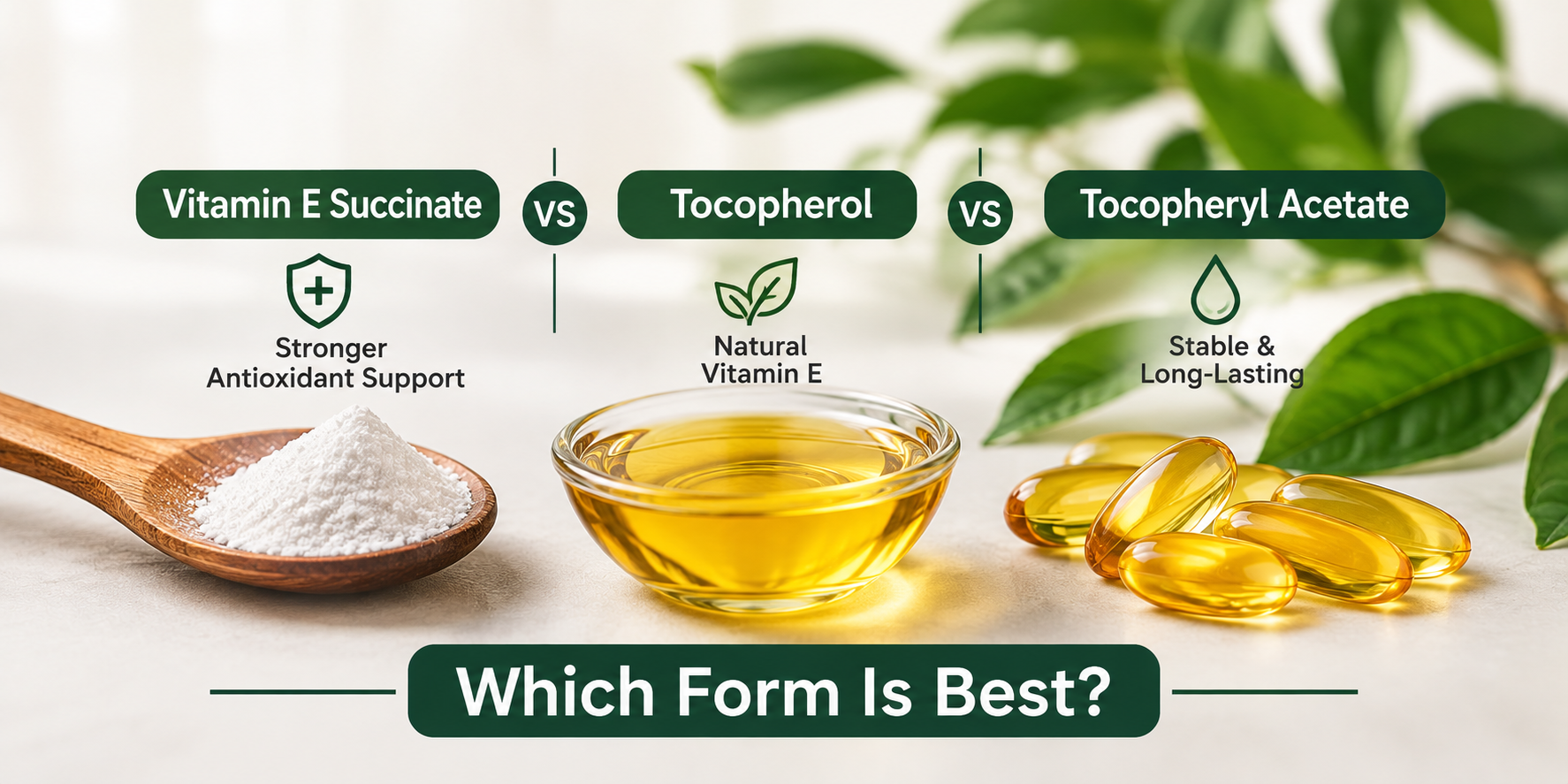
Vitamin E is one of the most versatile and widely used antioxidant ingredients, widely used in the pharmaceutical, nutraceutical, food, and cosmetic industries. However, many people mistakenly believe that all forms of vitamin E are the same.
Vitamin E is available in different forms, each with unique properties, stability, absorption characteristics, and applications.
Among the most common forms of Vitamin E are Succinate, Tocopherol, and Tocopheryl Acetate. Despite having the same source, these forms of vitamin E serve different purposes depending on the formulation and intended use.
Understanding Vitamin E
Vitamin E is a naturally-derived fat-soluble antioxidant, which helps protect cells from oxidative stress caused by free radicals. It is very useful to maintain skin health, support the immune system, and protect lipids from oxidation.
The vitamin E family includes eight naturally occurring compounds:
- Four tocopherols
- Four tocotrienols
Among all these compounds, alpha-tocopherol is one of the most biologically active forms in the human body. It also serves as the foundation for several commercially available vitamin E derivatives.
What Is Tocopherol?
Tocopherol, an active form of vitamin E, is immediately available for antioxidant activity without requiring conversion inside the body. Due to its unique antioxidant properties, tocopherol is widely used in:
- Dietary supplements
- Functional foods
- Cosmetic formulations
- Pharmaceutical preparations
- Food preservation
What Are the Advantages of Tocopherol?
Tocopherol comes with many advantages, some of which include:
- Immediate antioxidant action — Being in active form, tocopherol starts neutralising free radicals immediately.
- Natural label appeal — Tocopherol is commonly used in clean-label products and premium skincare formulations.
- Supports product stability — It is useful for delaying oxidation in oils and fats, improving product shelf life.
What Are Limitations of Tocopherol?
Tocopherol is very sensitive to oxygen, heat, and light. Another drawback of Tocopherol is that it oxidises relatively quickly, making formulation more challenging in products with long shelf-life requirements.
What Is Tocopheryl Acetate?
Tocopheryl acetate is another common form of vitamin E, which is created by attaching an acetate group to tocopherol.
The unique modification process helps improve stability during manufacturing, storage, and transportation.
Once tocopheryl acetate is absorbed by the body, it releases active tocopherol.
What Are the Advantages of Tocopheryl Acetate?
- Excellent stability — Tocopheryl Acetate is highly resistant to oxidation, making it suitable for products requiring extended shelf life.
- Ideal for skincare — Tocopheryl Acetate is used for manufacturing creams, lotions, and serums because it remains stable inside cosmetic formulations.
- Suitable for supplements — Tocopheryl Acetate is included in many oral vitamin E supplements due to its stability during storage.
What Are Limitations of Tocopheryl Acetate?
Since tocopheryl acetate is less active than tocopherol, it is mandatory to convert it into free tocopherol before providing antioxidant benefits. This additional step results in further delay in the manufacturing process and may also vary depending on the application and biological environment.
What Is Vitamin E Succinate?
Vitamin E succinate, also referred to as tocopheryl succinate, is another form of vitamin E, which is a combination of tocopherol and succinic acid.
Due to its unique specification, it offers greater chemical stability than free tocopherol while possessing certain qualities that make it valuable for pharmaceutical and nutraceutical formulations.
It is widely used for specialised research applications because of its unique biological behavior.
What Are the Advantages of Vitamin E Succinate
- Improved formulation stability — It helps protect vitamin E from premature degradation.
- Suitable for tablets and capsules — The excellent handling properties make it suitable for making solid dosage nutraceutical and pharmaceutical products.
- Well-established supplement ingredient — Commonly used in manufacturing premium dietary supplements where stability and manufacturing consistency are important.
What Are the Limitations of Vitamin E Succinate
Vitamin E succinate is a specialized form of vitamin e, which requires conversion into active tocopherol after ingestion to provide vitamin E activity.
Key Differences Between the Three Forms
| Feature | Tocopherol | Acetate | Succinate |
|---|---|---|---|
| Active form | Yes | No | No |
| Stability | Moderate | Excellent | Excellent |
| Requires conversion | No | Yes | Yes |
| Common applications | Foods, supplements, cosmetics | Cosmetics, supplements | Nutraceuticals, pharmaceuticals |
| Shelf-life | Moderate | Long | Long |
| Oxidation resistance | Lower | High | High |
Which Form Is the Best for Cosmetic Products?
Tocopheryl acetate is the highly suitable form of vitamin E for skincare and cosmetic products because it remains stable throughout product manufacturing and storage.
It is commonly incorporated into:
- Moisturisers
- Anti-ageing creams
- Facial serums
- Sunscreens
- Body lotions
- Lip care products
Which Form Is Best for Dietary Supplements?
For manufacturing dietary supplements, tocopherol and vitamin E succinate are widely used forms of vitamin E.
Manufacturers may choose:
- Tocopherol when immediate antioxidant availability is desired.
- Vitamin E succinate when formulation stability or controlled manufacturing processes are priorities.
Which Form Is Best for Pharmaceutical Applications?
For manufacturing of pharmaceutical products, vitamin E succinate is frequently selected due to its excellent stability and compatibility with solid dosage manufacturing.
Several physical characteristics of succinate make it easier to process during tablet compression and capsule filling without affecting the product quality throughout storage.
Final Words
There is no single "best" form of vitamin E, as each of them have their own unique characteristics. While tocopherol is an active form with immediate antioxidant activity but also comes with less stability, tocopheryl acetate offers exceptional stability. Similarly, vitamin E succinate combines stability with excellent suitability for pharmaceutical and nutraceutical products.